DjangoBooks.com
Blog - Page 477


Mario Maccaferri was born in 1900 in Cento, near Bologna, in Italy. At the age of 11, he became apprenticed to the Italian master luthier and renowned musician, Luigi Mozzani. The young Maccaferri assiduously followed his master’s footsteps, bearing his influence for the rest of his life. While learning lutherie, he concurrently pursued the study of the classical guitar. In 1916, he entered the Conservatory at Sienna, remaining there for ten years and graduating with the highest diploma and all honors. Subsequently, he abandoned lutherie to fully devote himself to a career of concert guitar performance. To critical acclaim, his touring took him across all of Europe. Maestro Mozzani, a superb guitarist and composer for the instrument in his own right, was quite proud of Mario Maccaferri, whom he regarded as a master luthier, musician and peer – an honor never bestowed upon any other of his many protégés.
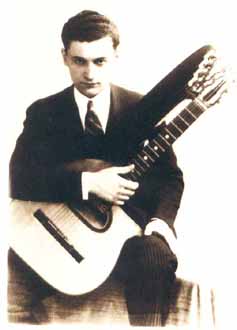
These two MP3s are the only suriving recordings of Mario Maccaferri:
In 1929, Maccaferri settled in London where, amidst his touring schedule, he taught guitar. Ever passionate about lutherie, he dreamt continually of a more ideal, more sonorous guitar. Before long he generated several new prototypes. Presented in London at the dawn of the 1930’s, these were the progenitors of his most lasting contribution to lutherie.
Upon being shown these latest creations, the Davis brothers, who managed Selmer’s London dealership, in turn introduced Maccaferri to Henri Selmer himself. With their assurances and in consideration of Maccaferri’s formidable lutherie background with Mozzani, Monsieur Selmer accepted the idea of constructing guitars within the Selmer manufacturing facility at Mantes-la-Ville, near Paris.
Soon enough, the atelier was begun under Maccaferri’s direction. He drew up the plans for the guitars, had molds and jigs made. Numerous workers, for the most part Italians, took part in the building of the shop and received training from Maccaferri in his production techniques.
On the sixth of May 1932, patent #736,779 was registered in Paris, entitled “Perfectionnements aux violons, guitars, mandolines et autres instruments à cordes.” Its résumé proposed:
-
“The joining to guitars, violins, mandolins and
other
musical instruments of an internal resonating box, affixed to
the vibrating top of the instrument…”
During this brief but revolutionary epoch the first Selmer Maccaferri guitars were produced. Maccaferri supervised the fabrication of each model. Even the cases for the guitars were made there.
By 1933, with production completely operational, Mario Maccaferri was increasingly less in evidence at the atelier. It seems there was a dispute with Henri Selmer which led to a peremptory departure from the firm some time late in 1933. Was it a contract problem? The Selmer company remains discreet on this subject to this day.
A consummate guitarist, Maccaferri longed to return to touring, to travel and perform once again around Europe. During the summer of 1933, however, a freak swimming accident badly injured his right hand, bringing his concertising career to an end.
Yet his life continued. During his time at Selmer, he had discovered and learned the technique of making reeds for saxophones and clarinets. Maccaferri oriented himself from then on with the making of reeds, creating his “French-American Reed Manufacturing Company.” In 1935 he filed for a patent for his shaping of reeds. In 1938, he set up a branch of that business in New York, moving there the next year in order to flee the war in France.
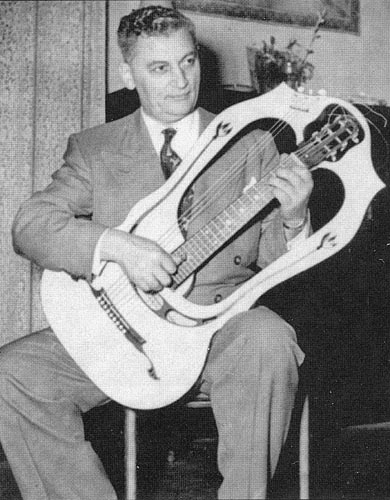
Surmounting yet another setback, when the primary source of reed making cane from southern France was cut off by wartime shipping problems, Maccaferri developed a viable plastic reed, the Maccaferri Futurity reed. Endorsed by Benny Goodman and others, his reedmaking enterprise survived the hazards of wartime shortages and propelled him into a thriving business in plastics.
This informal performance at a Gypsy party features Jan Limberger, the patriarch of the Limberger family. Sinti musicians from Jan’s generation grew up playing the traditional Hungarian violin repertoire. Jan, like many of his peers, also took up the guitar which he plays in the Django style. Fapy Lafertin, Martin Limberger, and Vivi Limberger play rhythm guitar. Jan Limberger is playing the violin. Martin Limberger is considered one of the worlds best rhythm guitarists.
Fapy also appears on the Django Legacy DVD.
The Limbergers can be heard on the CD The Gypsy Guitar Festival 1998.
Martin Limberger plays rhythm guitar for Tchavolo Schmitt on the CD Loutcha.
The video archive is dedicated to Mary Honcoop. She generously shared her large collection of Gypsy videos with nearly anyone who asked. The video archive aims to continue her generosity now that she is gone.
The Video Archive is devoted surviving video of Django Reinhardt and other masters of the Gypsy jazz genre. If you enjoy these videos consider making a donation.
To view this video you need Windows Media Player software. Download for free here: Windows Media Player